Hakka Kinship Terms
Firstly, ASCII IPA renderings of the character readings are given. For a chart, click here. I have used the tone contours of Shatoujiao, as I say them, so they may not be the same for all and every speaker of Hakka.
I'd just like to make it clear that some of these terms are probably not used, and more theoretical than used everyday. There is a short verse which is a rough measure of how 'related' we are to family members stemming from a female's side of the family.
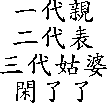
/jit3 t'Oi53 ts'in33/
/Ni53 t'Oi53 piau32/
/sam33 t'Oi53 ku34 p'O11/
/han11 liau32 liau32/
First generation close
Second generation cousins
Third generation Great Aunt
Nothing doing!
This implies that once Great Aunt passes away, the 'relatedness' link to her family can be severed.
Kinship terms in Hakka and other Chinese ethnic groups are split into three main categories.
- Paternal Kin
All descendents who share a common male ancestor and retain the ancestor's surname are known as the paternal kin, or "tong2" /toN11/. In relation to oneself, the sons and daughters of one's paternal uncles and brothers are part of the greater tong family circle.
- Maternal Kin
Mother's side of the family. Mother's blood relatives, who share her surname and their spouses.
- Grand Maternal Kin
Grandmother's side of the family. Grandmother's blood relatives who share her surname and their spouses.
Chinese family relationships are firmly based on the unit of the 'generation', toi4 /t'Oi53/.
The use of "older" and "younger" are in comparison to the age of a relative of the same generation as one's direct ancestor.
Comapared to western family kinship terms, those folks who are of the same generation as oneself, either as a cousin via an uncle (or more distantly related relations who are of the same generation) are called brothers and sisters. Likewise, those of the same generation as one's parent's are refered to as uncles and aunts. In English, these cousins are many times removed, but in Chinese, there are no indications as to how close these relations are.
When a daughter married, she is said to have been 'sold', and effectively, her offspring are those of her husband's family and hence outside of her father's family.. This is indicated by the word 'ngoi4' /NOi53/, which means 'outside'. Her bride's parents have thus "sold their daughter", or, 'mai4 moi4 zi1; /mai53 moi53 tsi.33/.
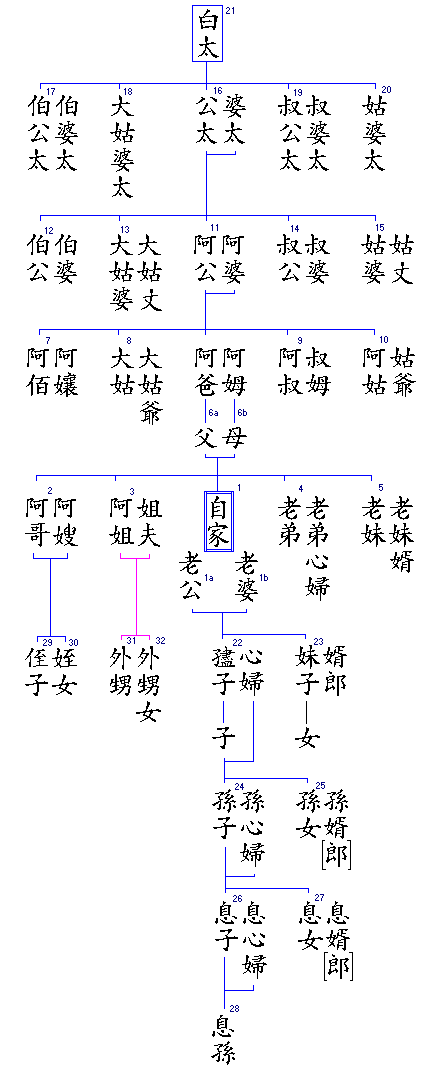
Father's Side of the Family
1. Me /ts'i.11 ka33/
1a. Husband /lau32 kuN33/
1b. Wife /lau32 p'O11/
2. Older brother /a33 gO33/, sister-in-law /a35 sau32/
3. Older sister /a35 tsia32/, brother-in-law /tsia32 fu33/
4. Younger brother /lau32 t'ai33/, sister-in-law /lau32 t'ai34 c.im33 k'iu33/
5. Younger sister /lau32 mOi53/, brother-in-law /lau32 mOi53 se53/
6. Parents /fu53 mu33/
6a. Father /a33 ba33/
6b. Mother /a33 ma33/, /a33 me33/, /a33 mi33/
7. Older Uncle /a35 pak3/, Aunt /a35 NiON11/
8. Older Aunt /a33 ku33/, Uncle /ku35 ja11/
9. Younger Uncle /a35 suk3/, Aunt /suk3 me33/
10. Younger Aunt /a33 ku33/, Uncle /ku35 ja11/
11. Grandfather /a33 kuN33/, Grandmother /a33 p'O11/
12. Older Great Uncle /pak3 kuN33/, Great Aunt /pak3 p'O11/
13. Older Great Aunt /t'ai53 ku34 p'O11/, Great Uncle /t'ai53 ku33 tsON33/
14. Younger Great Uncle /suk3 kuN33/, Great Aunt /suk3 p'O11/
15. Younger Great Aunt /ku34 p'O11/, Great Uncle /ku33 tsON33/
16. Great Grandfather /kuN33 t'ai53/, Great Grandmother /p'O11 t'ai53/
17. Older Great Great Uncle /pak3 gung33 t'ai53/, Great Great Aunt /pak3 p'O11 t'ai53/
18. Older Great Great Aunt /t'ai53 ku34 p'O11 tai53/
19. Younger Great Great Uncle /suk3 kuN34 tai53/, Great Great Aunt /suk3 p'O11 t'ai53/
20. Younger Great Great Aunt /ku34 p'O11 t'ai53/
21. Great Great Grandparent /p'ak5 t'ai53/
22. Son /lai53 tsi.33/, Daughter-in-law /c.im33 k'iu33/
23. Daughter /mOi53 tsi.33/, Son-in-law /se53 lON11/
24. Grandson /sun33 tsi.33/, Grand Daughter-in-law /sun33 c.im33 k'iu33/
25. Granddaughter /sun33 ng32/, Grand Son-in-law /sun33 se53 (lON11)/
26. Great Grandson /set3 tsi.33/, Great Grand Daughter-in-law /set3 c.im33 k'iu33/
27. Great Granddaughter /set3 Ni32/, Great Grand Son-in-law /set3 se4 (lON11)/
28. Great Great Grandchild /set3 sun33/
29. Nephew /ts'it5 tsi.33/
30. Niece /ts'it5 Ni32/
31. Nephew /NOi53 saN33/
32. Niece /NOi53 saN33 Ni32/
Other terms:
Not mentioned in the Chinese text above, are other words used for members of the family.
- I /Nai11/
- Family /ka33/
- Family /ka34 t'in11/
- Sisters /tsi.32 mOi53/
- Brothers /hiuN33 t'i53
- Brothers and sisters /hiuN33 t'i53 tsi.32 mOi53/
- Paternal Kin Cousins /suk3 pak3 hiuN33 t'i53/
- Children /tsi.32 N32/
- Child /a33 mOi53/
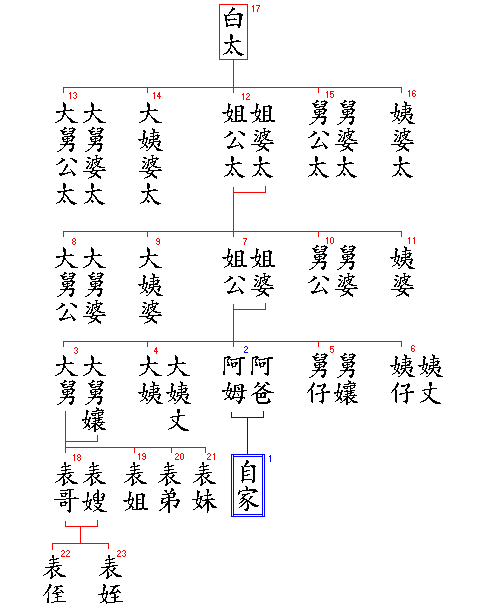
Mother's Side of the Family
1. Myself /ts'i.11 ka33/
2. Mother /a33 me33/, Father /a33 ba33/
3. Older Uncle /tai53 k'iu33/, Aunt /tai53 k'iu34 NiON11/
4. Older Aunt /tai53 ji11/, Uncle /tai53 ji22 NiON11/
5. Younger Uncle /k'iu35 tsai32/, Aunt /k'iu35 NiON11 tsai32/
6. Younger Aunt /ji11 tsai32/, Uncle /ji11 ts'oN33/
7. Grandfather /tsia32 kuN11/, Grandmother /tsia32 p'O11/
8. Older Great Uncle /t'ai53 k'iu33 kuN33/, Great Aunt /t'ai53 k'iu34 NiON11/
9. Older Great Aunt /t'ai53 ji11 p'O11/
10. Younger Great Uncle /k'iu33 kuN33/, Great Aunt /k'iu35 p'O11/
11. Younger Great Aunt /ji11 p'O11/
12. Great Grandfather /tsia32 kuN33 t'ai53/, Great Grandmother /tsia32 p'O11 t'ai53/
13. Older Great Great Uncle /t'ai53 k'iu33 kuN33 t'ai53/, Great Great Aunt /t'ai53 k'iu33 p'O11 t'ai53/
14. Older Great Great Aunt t'ai53 ji11 p'O11 t'ai53/
15. Younger Great Great Uncle /k'iu33 kuN33 t'ai53/, Great Great Aunt /k'iu35 p'O11 t'ai53/
16. Younger Great Great Aunt /ji11 p'O11 t'ai53/
17. Great Great Grandparent /p'ak5 t'ai53/
18. Older male 'first' cousin /piau32 kO33/, his spouse /piau32 sau32/
19. Older female 'first' cousin /piau32 tsia32/
20. Younger male 'first' cousin /piau32 t'i53/
21. Younger female 'first' cousin /piau32 mOi53/
22. Male 'second' cousin /piau32 ts'it5/
23. Female 'second' cousin /piau32 ts'it5/
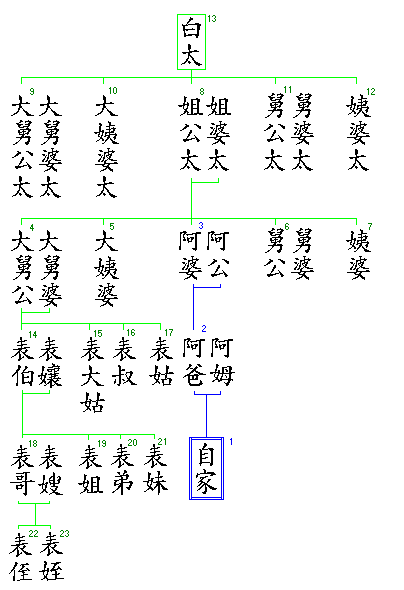
Paternal Grandmother's Side of the Family
1. Myself /ts'i.11 ka33/
2. Mother /a33 me33/, Father /a33 ba33/
3. Grandfather /a33 kuN33/, Grandmother /a33 p'O11/
4. Older Great Uncle /t'ai53 k'iu33 kuN33/, Great Aunt /t'ai53 k'iu34 NiON11/
5. Older Great Aunt /t'ai53 ji11 p'O11/
6. Younger Great Uncle /k'iu33 kuN33/, Great Aunt /k'iu35 p'O11/
7. Younger Great Aunt /ji11 p'O11/
8. Great Grandfather /tsia32 kuN33 t'ai53/, Great Grandmother /tsia32 p'O11 t'ai53/
9. Older Great Great Uncle /t'ai53 k'iu33 kuN33 t'ai53/, Great Great Aunt /t'ai53 k'iu33 p'O11 t'ai53/
10. Older Great Great Aunt t'ai53 ji11 p'O11 t'ai53/
11. Younger Great Great Uncle /k'iu33 kuN33 t'ai53/, Great Great Aunt /k'iu35 p'O11 t'ai53/
12. Younger Great Great Aunt /ji11 p'O11 t'ai53/
13. Great Great Grandparent /p'ak5 t'ai53/
14. Older Male "First Cousin Once Removed" /piau32 pak3/, his spouse /piau32 NiON11/
15. Older Female "First Cousin Once Removed" /piau32 t'ai53 ku33/
16. Younger Male "First Cousin Once Removed" /piau32 suk3/
17. Younger Fale "First Cousin Once Removed" /piau32 ku33/
18. Older Male "Second Cousin" /piau32 kO3/, his spouse /piau32 sau32/
19. Older Female "Second Cousin" /piau32 tsia32/
20. Younger Male "Second Cousin" /piau32 t'i53/
21. Younger Female "Second Cousin" /piau32 mOi53/
22. Male "Second Cousin Once Removed" /piau32 ts'it5/
23. Female "Second Cousin Once Removed" /piau32 ts'it5/
Other Relationships not shown directly
The kinship trees above forms a general framework on how to relate to family relationships in Hakka. There is a repetitive nature to this system, which may confuse because of the English terminology. Remember right at the start we said:
Chinese family relationships are firmly based on the unit of the 'generation', toi4 /t'Oi53/.
The use of "older" and "younger" are in comparison to the age of a relative of the same generation as one's direct ancestor.
We therefore count cousins who are in the same generation as oneself from a common ancestor as being "brothers and sisters". Those who are in our parent's generation are therefore our "uncles and aunts" and so on, even though they may be our nth cousins several times removed.
Hakka Index :
Site Index
© Dylan W.H. Sung 2000
This page was created on Thurday 27th January 2000.
It was recently updated on Friday 28th January 2000.